
LOCATION
Coordinates: 56.976918, 13.532623
Address: Unknown
Today, it feels like stepping into a primeval forest, but for 2,000 years, this area was used for cultivation. More than 600 clearance cairns remain, marking the ancient agricultural landscape. For those interested in lichens and mosses, Ödegärdet is a paradise. Here, you can find common species such as yellow scale lichen and blue-gray powder lichen, but also rarities like large button lichen and barnacle lichen. Follow the marked nature trail to learn more about the area’s history.
Ödegärdet is a beautiful and biologically valuable hiking area with plenty of ancient agricultural traces. Moss-covered stone piles, known as clearance cairns, are among the most common. These cairns bear witness to a time when the land was cleared of stones to make room for cultivation. There are also prehistoric graves and remains of old roads. Age determinations of the ancient remains have shown that the land was first used around 500 BCE, during the transition between the Bronze and Iron Ages.
Agriculture likely continued until the early 1500s. The place received its name after cultivation ceased, but despite its name, it has never been truly abandoned. Instead, the land was used, to varying extents, as meadow and pastureland until the 20th century. Since then, the forest has gradually reclaimed the area.
Nature Trail Tells the Story of the Area
A nature trail in the reserve provides more insight into the region’s history and culture. The trail is about two kilometers long.
Many Old Beeches
Today, Ödegärdet is home to one of the largest beech forests in southern Unnaryd parish. The average age of the beeches is around 150 years, but the oldest are approximately 250 years old. Here and in many other parts of Halland, beech trees have grown slowly under poorer conditions. This means that a small, thin, and crooked beech can be several times older than a tall, straight one that has grown in richer soil.
Glittering Green Mats
On the lower parts of the beech trunks, mosses form dense, green carpets. One moss found here is the indicator species glittering wood-moss, whose shoot tips are so bright that the entire mat appears to shimmer. This moss thrives in forests with high humidity and is evidence that the area has had continuous forest cover for many centuries.
A Record of Lichens
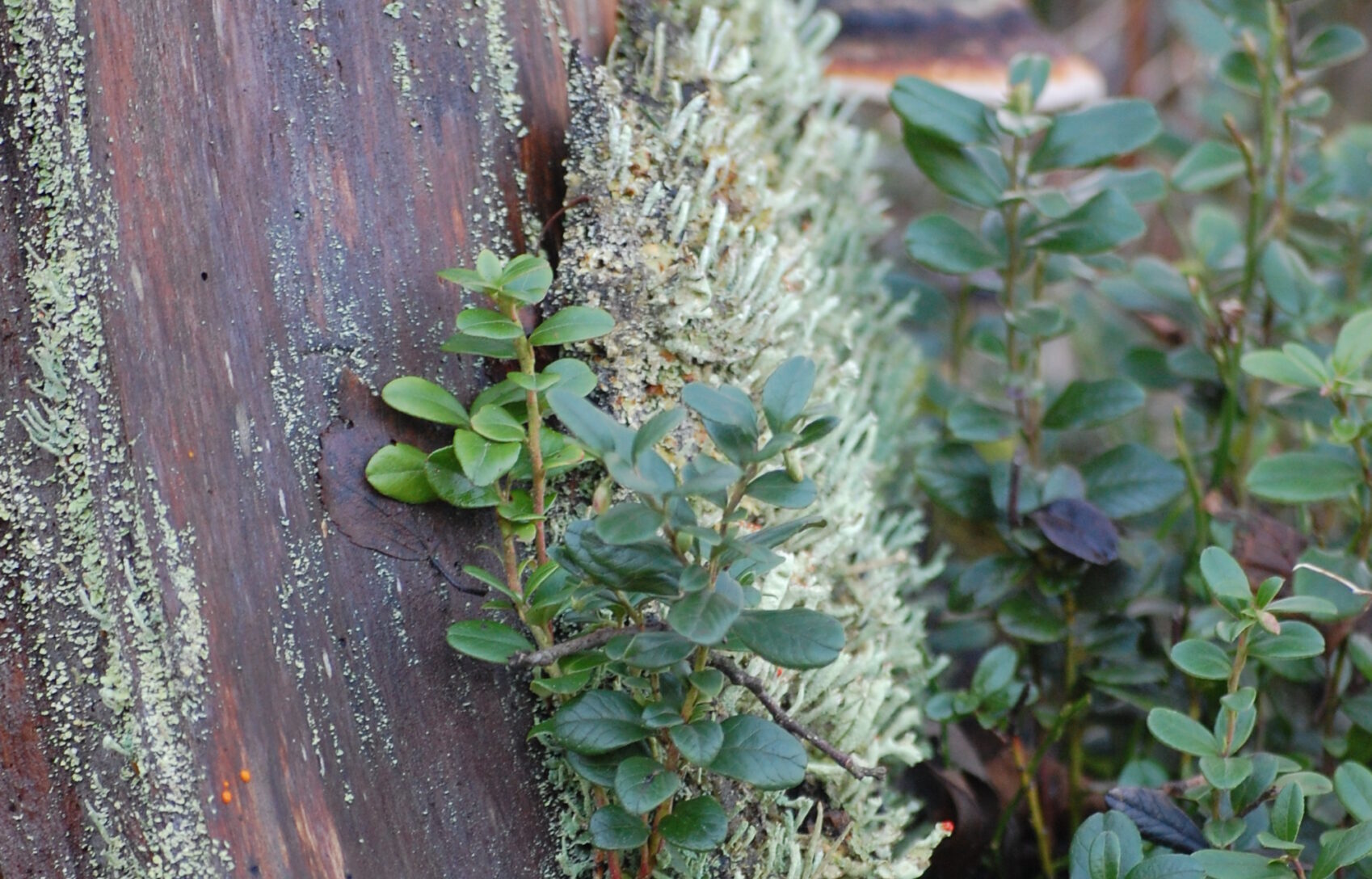
The beech trunks are also adorned with many gray-green patches. At first glance, they may seem insignificant, but a closer look with a magnifying glass reveals a world teeming with life—lichens. So far, more than 130 species of lichens have been identified on beeches in the reserve, making Ödegärdet one of the richest beech forests for lichens in Sweden. The most striking lichen in the area is lungwort, which hangs in large tufts from the trunks. When wet, it is a vibrant green, but when dry, it turns gray and brown. Experiencing the forest as the weather changes is remarkable. After a period of dry weather, lungwort may look almost dead, but when the rain arrives, it only takes a few seconds for it to revive, making the trunks shine in vivid green hues once more.
A Valuable Forest for Birds
The old beech forest is also crucial for birds that need tree cavities for nesting. Among the hole-nesting birds in the reserve are the green woodpecker, great spotted woodpecker, stock dove, black woodpecker, Eurasian nuthatch, and the red-breasted flycatcher. Another species that thrives in the deciduous forest is the oak eggar moth, a large moth from the emperor moth family.
Café and Accommodation Nearby
A café and restaurant can be found in the nearby town of Unnaryd, where there are also accommodation options.
Stamp in the Reserve
In some of our most remarkable reserves, you can also collect a beautiful stamp when you visit. You can stamp either directly in your guidebook or on your own paper/book. In Ödegärdet, the stamp is located at the viewpoint along the trail.










 Swedish
  English